
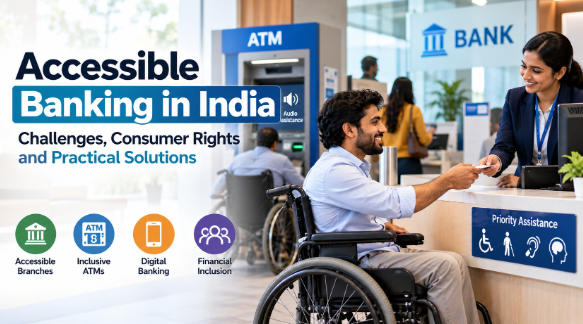
Access to banking services is essential for financial independence. People rely on banks to receive salaries and pensions, make payments, manage savings, and access credit. However, people with disabilities may face barriers when using bank branches, ATMs, mobile banking apps, and customer support services.
Accessible banking in India means ensuring that persons with disabilities can use financial services as independently and effectively as possible. This requires more than physical access to a bank branch. It also involves accessible digital platforms, clear communication, appropriate staff assistance, and fair access to banking facilities.
As financial services increasingly move online, banks and fintech companies must consider accessibility across the entire customer journey.
What Is Accessible Banking?
Accessible banking refers to financial services, facilities, communication systems, and digital tools that people with different disabilities can use effectively.
For example, a customer with a mobility impairment may need step-free branch access and a suitably positioned service counter. A customer with a visual impairment may require screen-reader-compatible banking applications, accessible account statements, or an ATM with audio guidance.
Deaf or hard-of-hearing customers may benefit from text-based customer support, while customers with cognitive disabilities may find clear language and straightforward instructions helpful.
The objective is to remove avoidable barriers while respecting each customer’s independence, privacy, and ability to make financial decisions.
Common Accessibility Barriers in Banking
1. Inaccessible Bank Branches
Steps at entrances, narrow pathways, inaccessible counters, and poorly arranged furniture can make visiting a bank difficult for customers with mobility impairments. Inadequate signage and inaccessible facilities can create additional obstacles.
Banks should assess the complete customer journey, from entering the building to reaching a counter, completing paperwork, and leaving safely.
2. Inaccessible ATMs
Customers with visual impairments may struggle with ATMs that lack usable audio guidance or tactile features. Customers with mobility impairments may face difficulties when controls are out of reach or there is insufficient space to manoeuvre.
The Reserve Bank of India has published customer-service guidance addressing accessible branches and ATMs, including talking ATMs with Braille keypads and facilities for visually impaired customers. Banks should review the applicable instructions and ensure that accessibility features are available and maintained.
3. Barriers in Digital Banking
Mobile banking and internet banking can reduce the need to visit a branch, but inaccessible technology can prevent customers from completing essential transactions.
Common problems include unlabeled buttons, poor text contrast, inaccessible authentication processes, and forms that do not work with screen readers or keyboard navigation.
Banks should test important customer journeys, including logging in, transferring money, downloading statements, and reporting suspicious transactions, with assistive technologies and users with disabilities.
4. Communication and Documentation Difficulties
Complex financial terminology, small-print documents, inaccessible forms, and limited communication options can make banking services difficult to use.
Customers should be able to understand essential information about fees, interest rates, loan conditions, and account restrictions. Depending on individual needs, accessible support may include readable digital documents, text-based communication, captions, or other suitable formats.
Staff training is equally important. Employees should communicate respectfully, address customers directly, and avoid assumptions about their abilities or decision-making capacity.
Disability Rights and Banking in India
India’s Rights of Persons with Disabilities Act, 2016, provides a legal framework addressing equality, non-discrimination, accessibility, and access to information and communication technology.
Banking accessibility is also governed by applicable Reserve Bank of India directions, banking regulations, and customer-service requirements. RBI guidance has addressed accessibility at branches and ATMs and the provision of banking facilities to visually impaired customers.
The precise legal obligations depend on the relevant provisions and circumstances. Banks should review applicable regulatory instructions, while customers should verify the rules relevant to their particular complaint.
Accessibility should be considered throughout the banking experience, including physical infrastructure, digital services, communication, documentation, and grievance handling.
Practical Steps Banks Can Take
Conduct Accessibility Audits
Banks should regularly assess branch entrances, pathways, counters, ATMs, websites, mobile applications, and customer support processes. Feedback from persons with disabilities can help identify barriers that routine internal checks may overlook.
Improve Digital Accessibility
Banking platforms should support assistive technologies through meaningful button labels, logical page structures, keyboard navigation, readable text, sufficient contrast, and clear error messages.
Accessibility testing should be part of product development and software updates rather than something introduced only after customers report problems.
Maintain Accessible ATMs
Banks should assess ATM positioning, controls, instructions, audio features, and physical access. Accessibility features must also work reliably. A feature that is installed but unavailable when needed does not provide effective access.
Train Employees
Frontline staff should understand disability etiquette, accessible communication, confidentiality, and procedures for responding to accessibility requests. Employees should know how to escalate unresolved issues to the appropriate team.
Provide Accessible Information
Customers should be able to access important banking information in usable formats. Banks should review their forms, statements, notices, and complaint procedures to reduce unnecessary complexity and communication barriers.
What Can Customers Do If They Face Banking Accessibility Problems?
Customers who encounter accessibility barriers can take the following practical steps.
Step 1: Document the problem. Record the date, branch or digital service involved, the barrier encountered, and its effect. Keep relevant correspondence, screenshots, complaint reference numbers, and acknowledgements. Never share passwords, PINs, or other sensitive account credentials unnecessarily.
Step 2: Complain directly to the bank. Contact the branch manager or the bank’s official grievance channel. Explain the accessibility issue and the resolution or adjustment being requested. Keep a copy of the complaint.
Step 3: Follow the bank’s escalation process. If the response is unsatisfactory, use the bank’s formal grievance mechanism and retain its replies. Check whether the matter meets the applicable requirements for external escalation.
Step 4: Consider the RBI complaint mechanism. The Reserve Bank–Integrated Ombudsman Scheme, 2026 provides a complaint-resolution mechanism for eligible complaints involving deficiencies in services by regulated entities covered by the Scheme. Customers should check its current eligibility and maintainability requirements before filing.
Complaints can be submitted through the RBI Complaint Management System at https://cms.rbi.org.in. The appropriate route depends on the institution, the nature of the issue, and the applicable rules.
Step 5: Seek assistance when necessary. Disability rights organisations, consumer support bodies, or qualified legal professionals may help customers understand their options. Any assistance should respect the customer’s decisions and protect confidential financial information.
The Role of Fintech Companies
Fintech companies influence how people make payments, transfer money, apply for credit, and manage their finances. Their design choices can either reduce accessibility barriers or create new ones.
Developers should test applications with assistive technologies and users with disabilities. Security measures should also be designed to remain usable without compromising account protection.
Including accessibility requirements in product planning, user testing, and customer support can help fintech companies identify barriers before they affect customers at scale.
Building a More Inclusive Banking System
Accessible banking requires coordinated efforts from banks, regulators, technology providers, and customers. Installing a ramp or launching a mobile application is not enough if other parts of the banking experience remain inaccessible.
Regular accessibility audits, inclusive digital design, reliable ATM features, employee training, and clear complaint procedures can help banks provide more usable services.
Customers must also have practical ways to report accessibility barriers and understand the options available to them.
Conclusion
Accessible banking in India is an important part of financial inclusion, equal participation, and consumer protection. Persons with disabilities should be able to use essential banking services without avoidable physical, digital, or communication barriers.
By improving branch accessibility, developing inclusive digital platforms, maintaining accessible ATMs, and responding effectively to complaints, banks can help customers manage their finances with greater independence and privacy.
Accessibility should be an ongoing responsibility, built into the design and delivery of financial services rather than treated as a one-time project.
Author Bio
This article explores financial inclusion, accessibility, and the challenges faced by persons with disabilities. For further information on disability rights, accessibility, and inclusion in India, visit Disability Activists.